AcademicEthics & Tech
Code and Power
Collaborative ProjectMatt SteinesHTML / CSSGitHub Pages
Code and Power is an educational website exploring how implicit bias shapes the digital systems we build and use every day. Built as an academic project with Matt Steines, it frames technology not as a neutral tool but as a reflection of the values — and blind spots — of its creators.
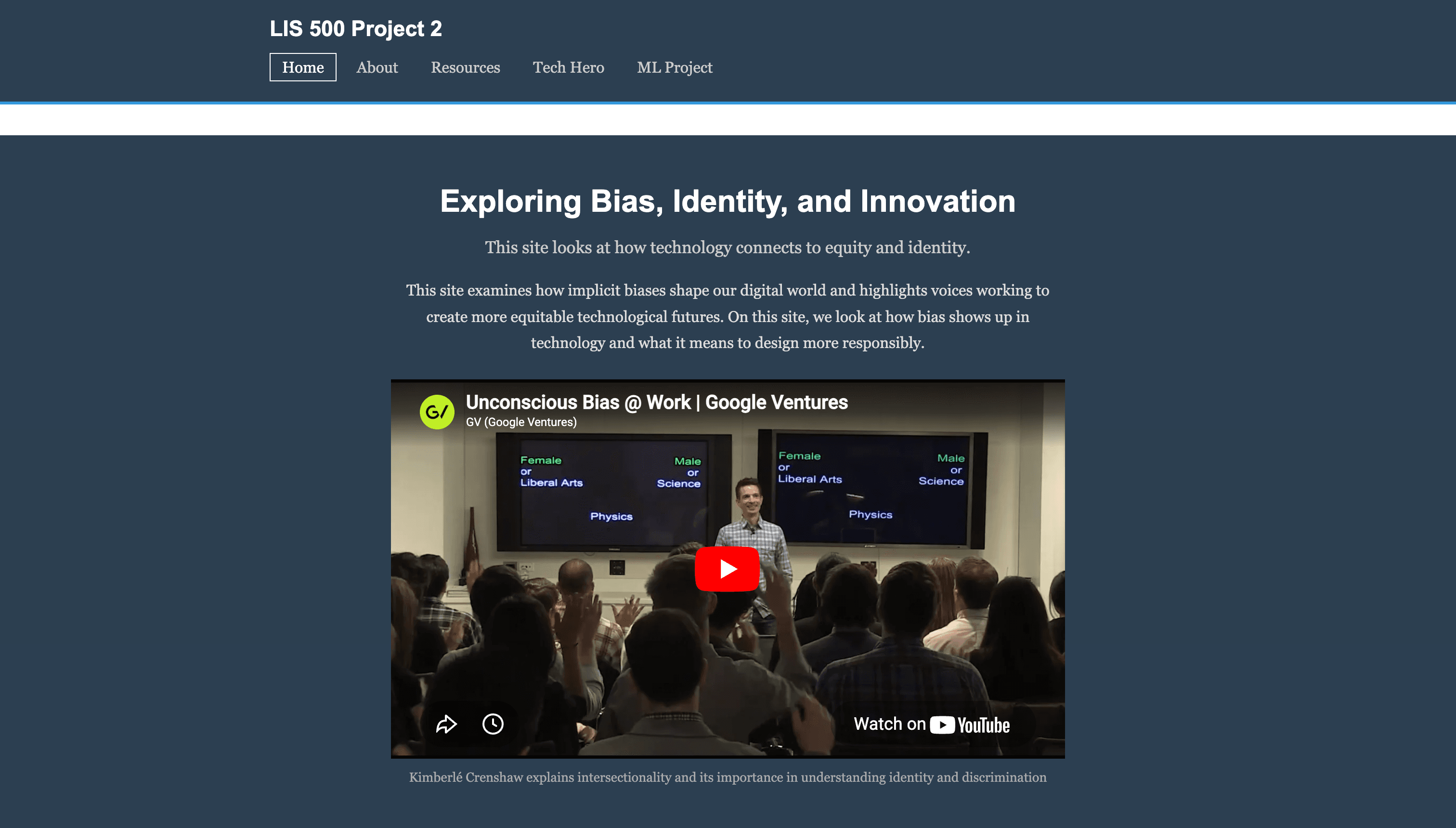
"If we aren't intersectional, some of us, the most vulnerable, are going to fall through the cracks."
— Kimberlé Crenshaw
The Core Question
- Who builds technology — and whose needs does it center? Every design decision encodes assumptions about the user.
- Implicit biases in machine learning datasets, hiring pipelines, and product teams compound over time, producing systems that serve some users well and others poorly.
- Recognizing this isn't pessimism — it's the first step toward building more equitable tools.
Intersectionality & Design
- Kimberlé Crenshaw's framework of intersectionality — originally developed for legal theory — translates directly into product thinking: a single-axis view of "the user" erases people who sit at overlapping margins.
- The site profiles innovators who actively work to advance equity across race, class, and gender, demonstrating that inclusion is an engineering constraint, not an afterthought.
- Educational resources on the site are designed for first-year students encountering these ideas for the first time, prioritizing clarity over jargon.
Machine Learning in Practice
- Using Google's Teachable Machine and TensorFlow.js, I trained a four-class image classifier to distinguish between two alpacas and two badgers — entirely from self-photographed images (548+ photos taken across varying lighting, angles, and distances).
- The model revealed a common ML trap: it learned shortcuts. It keyed on object size and camera distance rather than the animals' actual features — a fragile system that broke under new conditions.
- This connected directly to Joy Buolamwini's concept of the "coded gaze": when training data lacks diversity, the model inherits those gaps. Omission is itself a form of bias.
- Training happened entirely in-browser via MobileNet transfer learning, each iteration completing in 30–60 seconds — fast enough to iterate, slow enough to see where each version failed.
What I Learned
- Framing is a design choice. The way a problem is presented shapes which solutions feel possible — and which populations stay invisible.
- Collaboration across different disciplines produces better work. Matt brought a different lens; the friction was generative.
- Writing for a general audience is harder than writing for experts. Reducing complexity without losing accuracy is a skill I kept returning to.
Tools & Stack
HTMLCSSGitHub PagesTeachable MachineTensorFlow.jsMobileNetTransfer LearningIntersectional Design Thinking